
Proprietary Course MaterialsStandardized content updated in line with the course objectives.


Course
Building Effective OKRs
Building Effective OKRs
Enable participants to design clearly directed Objectives, measurable Key Results, and an OKR cycle aligned across the organization, teams, and individuals.
Table of Contents
1. Course Overview
OKRs can easily become a task list or another target system when Objectives lack direction, Key Results are not measurable, and goals are not aligned across levels. Implementation also loses momentum when organizations review only at the end of the cycle instead of maintaining regular check-ins and dialogue.
The course “Building Effective OKRs” guides participants in defining clear Objectives, designing outcome-based Key Results, aligning OKRs across the organization, teams, and individuals, and conducting check-ins and progress updates throughout the cycle.
Through exercises in developing and reviewing OKRs, participants learn to identify unclear objectives and unsuitable metrics and establish mechanisms for evaluation, learning, and improvement in the next cycle.
2. Learning Objectives
- Distinguish OKRs from KPIs, action plans, and task lists.
- Write Objectives that provide clear direction, are meaningful, and align with strategic priorities.
- Design Key Results that measure outcomes rather than merely describing activities.
- Align OKRs vertically and horizontally across units, teams, and individuals.
- Conduct check-ins, update progress, and address obstacles during the OKR cycle.
- Evaluate results, capture lessons learned, and improve OKR quality for the next cycle.
3. Target Participants
- Leaders and Executive Team MembersThose who set priorities and ensure enterprise-wide OKR alignment.
- Functional Directors and Department HeadsThose who develop unit OKRs and coordinate cross-functional goals.
- Team ManagersThose who set, monitor, and review OKRs with employees.
- Strategy, Performance, or Transformation ProfessionalsThose who design processes and support operation of the OKR cycle.
4. Course Outline
PART 01Foundations of OKRs in Goal Management
- The concept of OKRs in modern management.
- Differences among OKRs, KPIs, and day-to-day work.
- The role of OKRs in focusing priorities.
- Thinking ambitiously while remaining realistic.
- The alignment among strategy, teams, and individuals.
- The OKR cycle in business operations.
- Scenario: numerous goals without clear focus.
- Practice assessing current goal-setting practices.
PART 02Writing Clear and Inspiring Objectives
- Write concise, memorable, and directional Objectives.
- Focus on outcomes rather than activities.
- Select the most important objectives for the cycle.
- Link Objectives with strategic priorities.
- Avoid Objectives that are overly broad or operational.
- Criteria for assessing Objective quality.
- Example: converting a task into an Objective.
- Practice writing Objectives for a team.
PART 03Designing Measurable Key Results
- Identify the key results to be achieved.
- Write Key Results using specific metrics.
- Distinguish Key Results from action initiatives.
- Set clear progress thresholds.
- Balance output and impact measures.
- Avoid Key Results that do not measure outcomes.
- Scenario: an attractive OKR that is difficult to measure.
- Practice developing a sample set of Key Results.
PART 04Aligning OKRs Across the Organization, Teams, and Individuals
- Cascade OKRs from corporate to team level.
- Align goals horizontally across functions.
- Clarify each individual's contribution.
- Avoid copying OKRs across levels.
- Use dialogue to agree shared objectives.
- OKR alignment and accountability matrix.
- Scenario: functions establish conflicting OKRs.
- Practice developing an OKR alignment map.
PART 05Tracking Progress and Executing OKRs
- Establish a weekly OKR check-in rhythm.
- Update progress using actual data.
- Identify the risk of deviation early.
- Adjust initiatives while preserving the primary objective.
- Conduct concise, action-focused OKR meetings.
- An OKR dashboard for cycle monitoring.
- Scenario: OKRs are forgotten after launch.
- Practice designing an OKR check-in meeting.
PART 06Evaluating, Learning, and Improving the OKR Cycle
- Score OKRs transparently at the end of the cycle.
- Analyze the reasons for achievement and non-achievement.
- Capture lessons from ambitious objectives.
- Distinguish OKR evaluation from rewards and penalties.
- Improve OKR writing for the next cycle.
- Build a culture of commitment and learning.
- Scenario: employees are afraid to set ambitious goals.
- Practice developing an OKR implementation plan.
5. Training Methodology
Classes are delivered in small, learner-centered groups. Instructors provide concise input, then facilitate discussions, scenario-based practice, feedback, and reflection so participants can translate knowledge into practical workplace behaviors.
Group Discussions
Individual Exercises
Group Presentations
Brainstorming Techniques
Guided Practice with the Instructor
Experiential Projects
In-Class Activities
Role-Playing Activities
Class Presentations
6. Class Information
| Expected Start Date | Schedule | Class Hours | Location | Tuition Fee | Register |
|---|---|---|---|---|---|
| To Be Announced | Saturday – Sunday | 08:30 – 16:30 | Ho Chi Minh City | VND 4,500,000 | Register |
| To Be Announced | Monday – Thursday | 18:00 – 21:30 | Hanoi | VND 4,500,000 | Register |
10% discount for registration at least 15 days in advance, groups of three or more participants, or returning clients.Reserve a Seat
Note: The schedule above is provisional and may be adjusted based on enrollment, class arrangements, and the actual training plan. Masterskills will confirm the official schedule with participants before the course begins.
- Duration: 2 days / 4 sessions; maximum 35 participants per class.
- Ho Chi Minh City: 224 Dien Bien Phu Street, Ban Co Ward, Ho Chi Minh City.
- Hanoi: 51 Le Dai Hanh Street, Hai Ba Trung Ward, Hanoi.
- Corporate in-house training: Delivered at the client's office or factory; pricing depends on the design scope, location, and class size.
- Additional costs: Instructor travel and accommodation costs are determined by the delivery location, where applicable.
7. Learning Materials & Certification
Participants receive proprietary course materials developed by Masterskills, practical handouts, self-assessment forms, and reference materials aligned with real business situations.
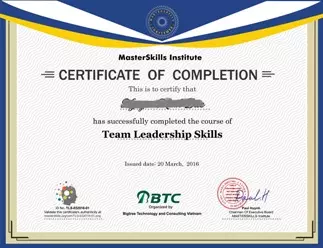
Course Completion Certificate
Participants who meet the attendance and practical requirements receive a Masterskills certificate of program completion.
8. Faculty
Masterskills instructors and experts bring practical management, consulting, and training experience relevant to the program content.
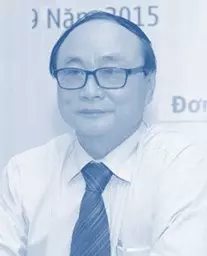
MBA. Đào Hoài Bắc
Human resources management and KPI–BSC expert specializing in performance management, KPIs, BSC, corporate culture, and management systems.

MBA. Paul Huỳnh
Leadership and capability development expert specializing in management skills, critical thinking, execution leadership, and coaching.
9. Masterskills Corporate Profile
An overview of Masterskills' training capabilities, areas of expertise, delivery methodology, and experience partnering with organizations.
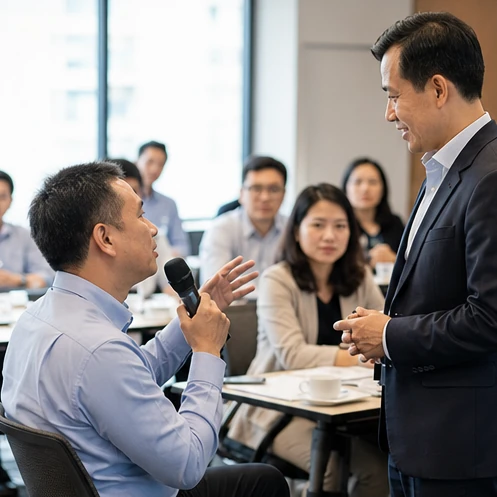
Client Testimonials
View More Client Testimonials“The Building Effective OKRs course offers practical content, workplace-relevant exercises, and clear facilitation. The instructor helps participants use appropriate tools, analyze situations, and develop solutions they can apply after the program.”
10. Selected Clients
Masterskills has delivered a number of corporate training programs with content closely related to this course topic.
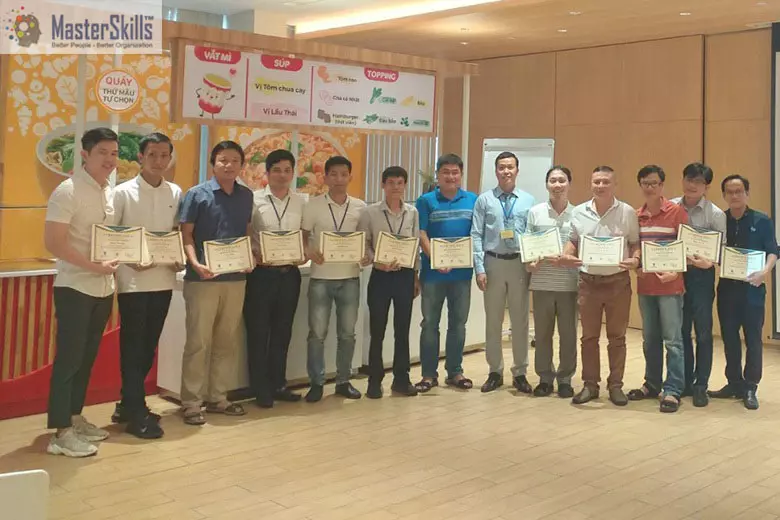 Risk Management & Information SecurityAcecook Vietnam – Ho Chi Minh City
.webp) Industrial Maintenance Management (TPM)ABB Vietnam – Bac Ninh
Industrial Maintenance Management (TPM)ABB Vietnam – Bac Ninh
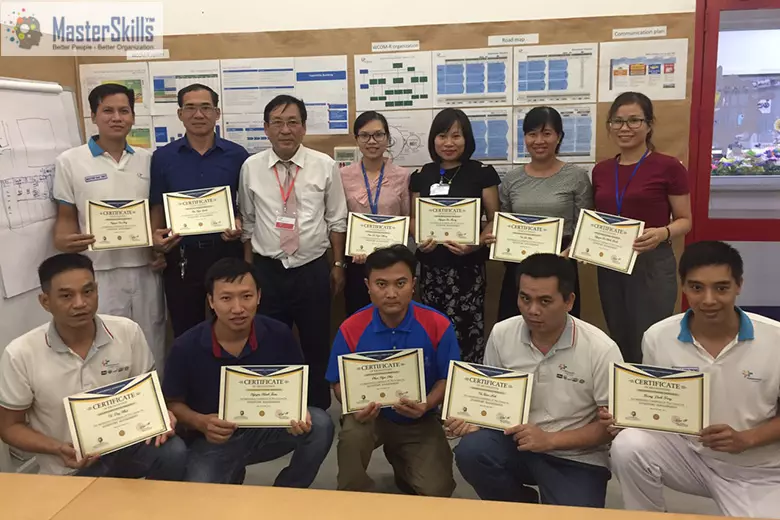 Warehouse ManagementFrieslandCampina – Ha Nam
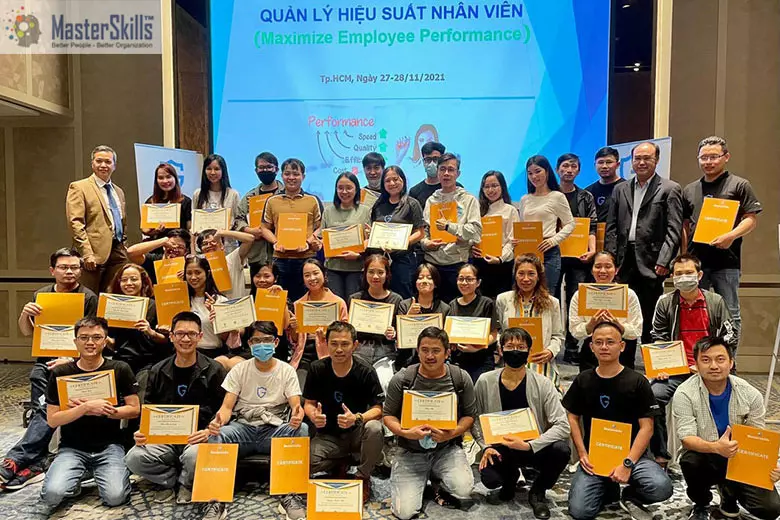 Employee Performance ManagementG-Comply Vietnam – Ho Chi Minh City
Industrial Maintenance Management (TPM)ABB Vietnam - Bac Ninh
Employee Performance ManagementG-Comply Vietnam – Ho Chi Minh City
Industrial Maintenance Management (TPM)ABB Vietnam - Bac Ninh
.webp) Industrial Maintenance Management - TPMGoldCoin FeedMill Long An
Industrial Maintenance Management - TPMGoldCoin FeedMill Long An
.webp) Industrial Maintenance Management - TPMVietnam Air Petrol Company (Skypec) - Ho Chi Minh City
Industrial Maintenance Management - TPMVietnam Air Petrol Company (Skypec) - Ho Chi Minh City
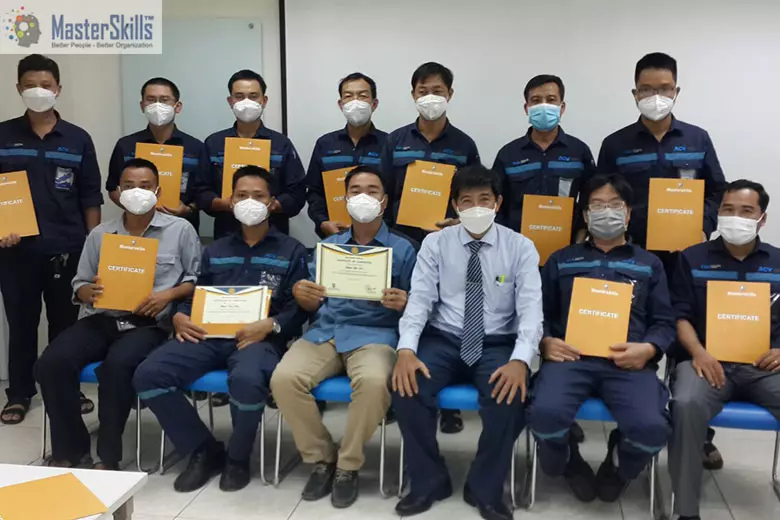 Industrial Maintenance Management - TPMTan Son Nhat International Airport – Ho Chi Minh City
Related Courses

Effective Human Resources ManagementDevelop effective human resources management capability through practical scenarios.

Optimizing Human Resources ManagementDevelop the capability to optimize human resources management through practical scenarios.

Job Standard DesignDevelop job-standard design capability through practical scenarios.

Recruitment Interviewing SkillsDevelop recruitment interviewing skills through practical scenarios.

Role and Responsibility AssignmentDevelop role and responsibility assignment capability through practical scenarios.
Building a 3P Compensation SystemDevelop the capability to build a 3P compensation system through practical scenarios.
Ready to strengthen your team's capability to build effective OKRs?
Masterskills experts are ready to advise you on a Building Effective OKRs program aligned with your organization's objectives.